
Can You Tell If Saffron Was Properly Dried—Just by Looking at It?
Laboratory analysis remains the gold standard for evaluating saffron quality. Yet many experienced buyers form an initial opinion long before a sample reaches the lab.
Not by smelling it.
Not by rubbing it between their fingers.
But simply by studying the threads themselves.
A well-dried saffron stigma leaves behind subtle visual clues—details that are easy to overlook but remarkably difficult to fake.
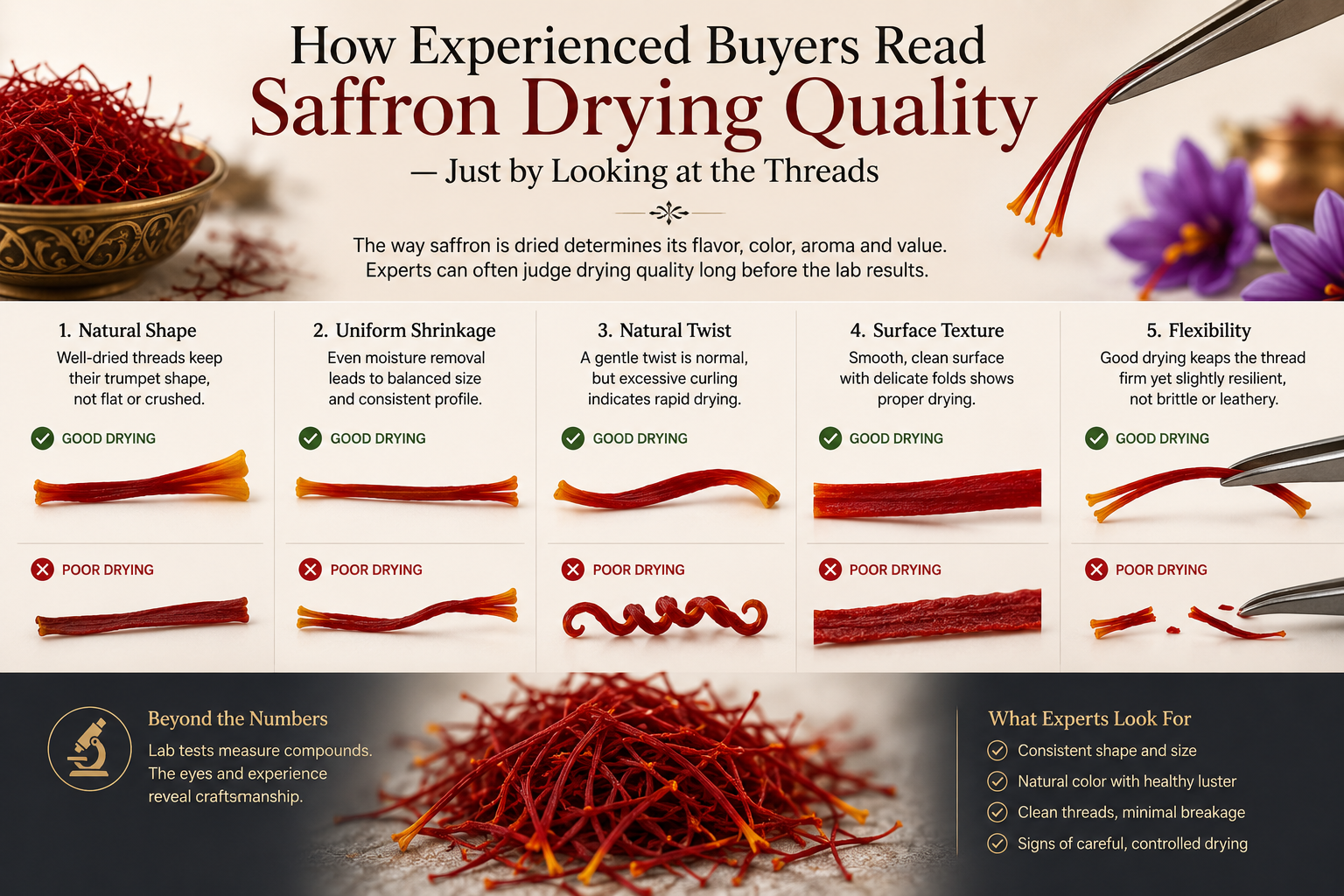
1. The Natural Shape of the Stigma
Properly dried saffron retains the elegant, trumpet-like structure of the stigma.
The thread should appear naturally curved rather than flattened or compressed. Each stigma should keep its own three-dimensional form instead of collapsing into a thin, lifeless strip.
Excessive heat often causes the tissue to shrink too rapidly, leaving the thread unnaturally flat or rigid. Slow, controlled drying is far more likely to preserve the original botanical structure.
Experienced buyers don’t just look at the color—they look at whether the saffron still looks like a flower that has simply lost its moisture.
2. Uniform Shrinkage Tells a Story
Every saffron thread shrinks during drying.
The question is how it shrinks.
When moisture leaves the stigma gradually, the reduction in size tends to be even along the entire thread. The profile remains balanced, with no abrupt thinning or distorted sections.
Poorly controlled drying often produces uneven shrinkage. One part of the thread may appear overly contracted while another remains comparatively swollen. This inconsistency usually reflects uneven moisture removal rather than natural variation.
Uniformity is one of the quietest indicators of careful processing.
3. Twisting Is Normal. Excessive Curling Is Not.
A gentle twist is a natural characteristic of dried saffron.
Aggressive curling, however, may indicate that moisture escaped too quickly. Rapid dehydration causes different parts of the stigma to contract at different rates, creating exaggerated bends or tight corkscrew-like shapes.
These highly distorted threads are rarely seen in carefully processed premium lots.
Seasoned buyers learn to distinguish between natural movement and stress caused by drying.
4. Surface Texture Reveals More Than Color
Most buyers focus on redness.
Professionals also examine texture.
A properly dried stigma usually has a smooth, clean surface with delicate natural folds.
Over-dried saffron often develops a rough, papery appearance. The surface may look dusty, excessively wrinkled, or slightly brittle under magnification.
Those subtle changes are often more informative than color alone.
5. Flexibility Still Matters
Appearance alone never tells the whole story.
After the visual inspection, experienced buyers usually handle a few threads.
Well-dried saffron should feel firm without becoming fragile. It may offer a slight resistance before breaking, indicating that the cellular structure has remained relatively intact.
Poorly dried saffron often fractures immediately, while under-dried saffron may feel soft or leathery rather than crisp.
Neither extreme reflects optimal processing.
Looking Beyond Laboratory Numbers
None of these observations replaces ISO 3632 testing.
Spectrophotometers can measure coloring strength, bitterness, and aroma compounds with exceptional accuracy.
What they cannot fully describe is craftsmanship.
The consistency of drying.
The preservation of the stigma’s natural structure.
The care taken between harvest and packaging.
These qualities are often visible to a trained eye long before they appear in a laboratory report.
For experienced saffron buyers, visual inspection is not about replacing science—it’s about recognizing the fingerprints of good processing before the analysis begins.
Leave a Reply