
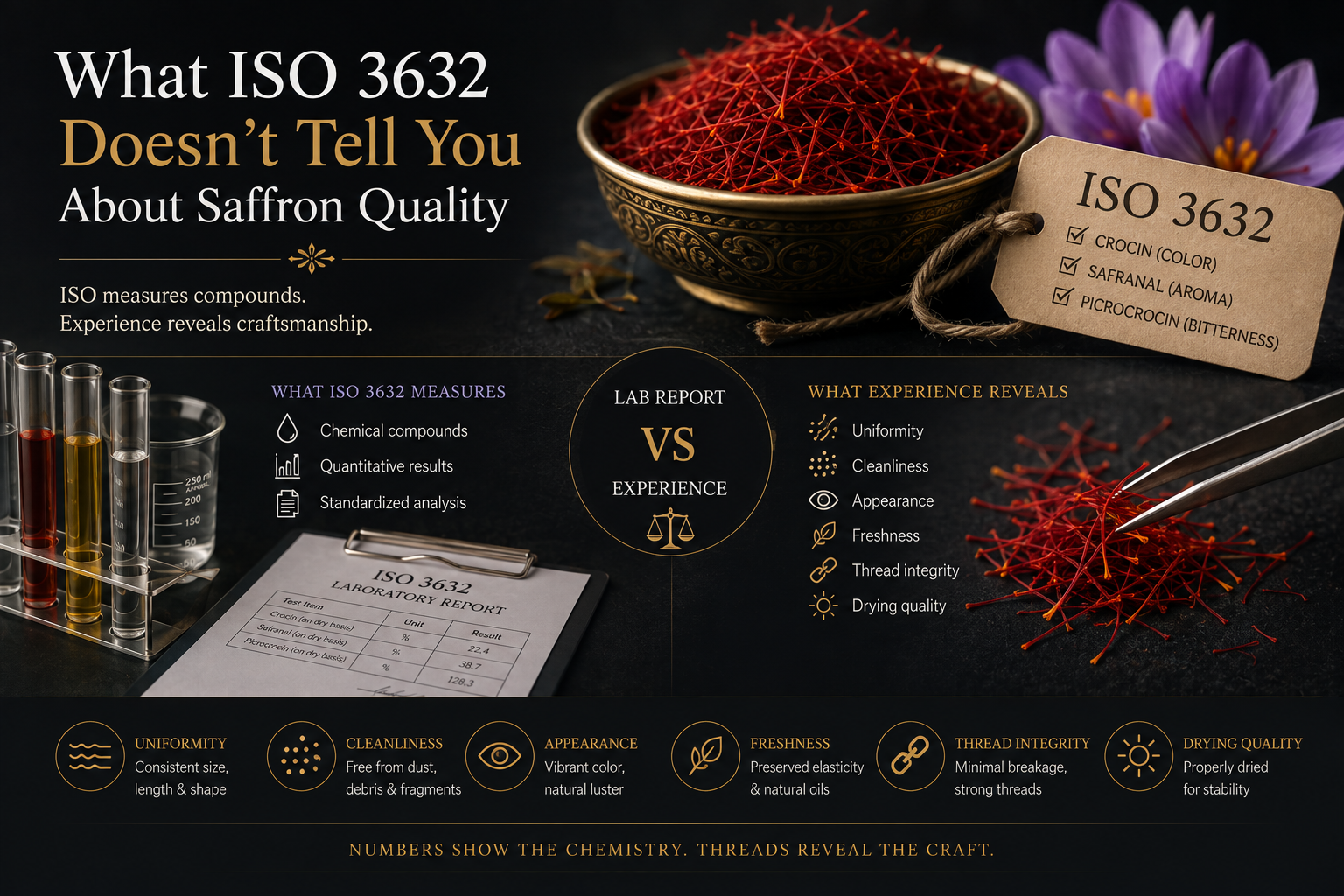
What ISO 3632 Doesn’t Tell You About Saffron Quality
For decades, ISO 3632 has been the global benchmark for evaluating saffron.
It measures the concentration of key compounds responsible for color, aroma, and flavor, allowing buyers and sellers around the world to speak the same technical language.
Without it, international saffron trade would be far less transparent.
But experienced buyers know something equally important:
A laboratory report describes the chemistry of saffron. It doesn’t tell the entire story of the product.
That’s where experience begins.
ISO Measures Compounds—Not Craftsmanship
ISO 3632 evaluates three primary quality indicators:
- Crocin (coloring strength)
- Safranal (aroma)
- Picrocrocin (bitterness)
These measurements are essential.
However, they cannot evaluate many of the physical characteristics that influence the commercial value of a saffron lot.
Two samples may receive nearly identical laboratory results while looking—and performing—very differently in the marketplace.
1. Uniformity
Open two cartons with identical ISO reports.
One contains beautifully matched threads of similar length, thickness, and appearance.
The other contains a mixture of long threads, broken pieces, and irregular fragments.
Both may achieve the same analytical values.
Only one creates confidence at first glance.
Uniformity reflects careful grading, sorting, and processing—qualities no spectrophotometer can measure.
2. Cleanliness
A laboratory report does not tell you whether a lot contains excessive floral debris, dust, fine particles, or broken fragments.
These imperfections may have little influence on crocin or safranal values, yet they immediately affect presentation, handling, and perceived quality.
Professional buyers notice them within seconds.
3. Thread Integrity
Every movement after harvest leaves a trace.
Repeated handling, aggressive mixing, poor packaging, or long transportation can increase thread breakage without dramatically changing laboratory results.
Broken threads don’t necessarily indicate poor chemistry.
They often indicate poor handling.
For premium buyers, that distinction matters.
4. Freshness Beyond Chemistry
Chemical compounds decline gradually over time.
Physical characteristics often change first.
Loss of elasticity, increased brittleness, surface dullness, and subtle structural changes may become noticeable before laboratory values show a significant difference.
An experienced buyer sees those signs immediately.
5. Visual Consistency
Premium saffron doesn’t simply have an attractive color.
It has consistency.
The threads should display a harmonious appearance, with balanced size, shape, and natural structure throughout the lot.
Visual consistency reflects disciplined production and careful quality control.
It cannot be summarized in a laboratory certificate.
6. Drying Quality
ISO analysis cannot explain how the saffron reached its current condition.
It cannot reveal whether drying was carefully controlled or rushed.
Yet the drying process influences thread structure, flexibility, appearance, and long-term stability.
Experienced buyers often recognize the fingerprints of good drying before opening a laboratory report.
Reading Between the Numbers
The best buyers don’t choose between laboratory testing and visual inspection.
They rely on both.
Laboratory analysis confirms chemical composition.
Visual inspection evaluates craftsmanship.
Together, they provide a far more complete understanding of quality than either could alone.
The Difference Between Compliance and Excellence
Meeting ISO 3632 means a saffron lot satisfies internationally recognized analytical standards.
Achieving exceptional quality requires something more.
It requires consistency from harvest to drying…
Careful grading…
Minimal mechanical damage…
Thoughtful handling…
And attention to details that no laboratory instrument is designed to measure.
The world’s most experienced saffron buyers rarely stop reading at the laboratory report.
Because in premium saffron, the numbers explain the chemistry—
but the threads tell the story.
Leave a Reply