
Why Some Saffron Exporters Deliver Consistent Quality—Every Single Time
One of the biggest misconceptions in the saffron trade is that quality begins in the field.
It doesn’t.
Harvesting determines the potential of a saffron crop. What happens after harvest determines whether that potential survives all the way to the customer.
This explains why two exporters sourcing from the same region—even the same harvest—can deliver products that perform very differently in the market.
The difference isn’t luck.
It’s process.
The exporters known for exceptional consistency rarely rely on a single outstanding harvest. Instead, they build systems that make quality repeatable.
Consistency Is an Engineered Outcome
Professional buyers often ask where a saffron lot was grown.
The better question is:
How was it prepared for export?
Consistency is created through hundreds of small decisions, each one reducing variation before the product reaches the customer.
The most successful exporters don’t simply pack saffron.
They engineer uniformity.
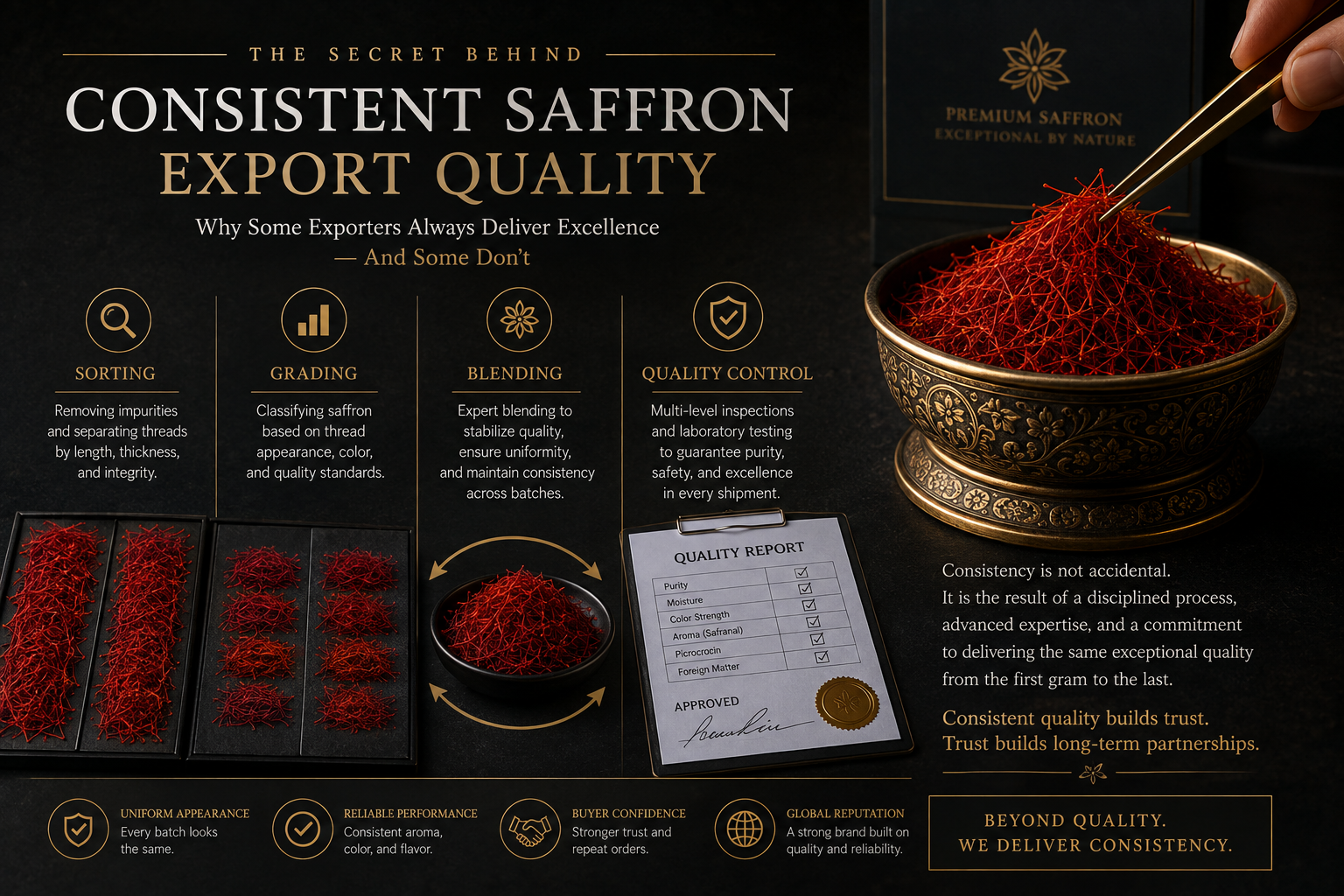
Sorting: Separating Similar from Identical
Many producers sort saffron.
Relatively few sort it precisely.
True sorting isn’t just about removing defects or separating grades. It is about ensuring that every thread inside a lot shares the same visual characteristics.
Length.
Thickness.
Shape.
Color distribution.
Thread integrity.
Even slight differences become visible when thousands of threads are packed together.
Experienced buyers may not consciously identify every variation—but they immediately recognize the overall impression of consistency.
That impression builds confidence.
Grading Is More Than Category Names
Terms such as Negin, Super Negin, Sargol, and Pushal describe commercial categories.
Professional grading goes much further.
Within a single commercial grade, exporters often encounter natural variation in thread size, maturity, color intensity, and physical appearance.
The best processors reduce that variation before packaging.
Rather than asking whether a lot is Negin, experienced buyers often ask a different question:
How consistent is this Negin from the first kilogram to the last?
That question is rarely answered by the label.
Blending Isn’t About Mixing—It’s About Stabilizing
The word blending sometimes carries a negative reputation.
In reality, controlled blending is one of the most important tools in professional saffron processing.
Every harvest contains natural variation.
Fields differ.
Flower maturity differs.
Harvest days differ.
Drying batches differ.
Without careful blending, each export lot would inherit those differences.
Professional blending does not hide quality.
It reduces variation.
Its purpose is to ensure that the first carton and the hundredth carton deliver the same visual appearance, aroma, and analytical profile.
In high-end food industries, consistency is considered quality.
Saffron should be no different.
Quality Control Begins Long Before the Laboratory
Many companies treat quality control as the final inspection.
Leading exporters treat it as a continuous process.
Quality is evaluated when saffron arrives.
During cleaning.
During sorting.
During grading.
After blending.
Before packaging.
Before shipment.
Each inspection removes another source of variability.
The laboratory becomes confirmation—not discovery.
The Invisible Cost of Inconsistency
A buyer may accept one shipment because the laboratory values meet specification.
What determines repeat business is something far less measurable.
Confidence.
When every shipment looks slightly different, buyers begin asking questions.
Has the source changed?
Was the harvest different?
Was another supplier used?
Even when the chemistry remains acceptable, inconsistency creates uncertainty.
And uncertainty is expensive.
Premium Buyers Don’t Purchase Samples—They Purchase Predictability
A beautiful sample is easy to produce.
Delivering that same quality across hundreds of kilograms—or multiple containers over several seasons—is an entirely different challenge.
The world’s most respected saffron exporters understand this.
Their reputation isn’t built on producing an exceptional sample.
It’s built on producing an exceptional sample every single time.
Consistency Is the Ultimate Quality Signal
Anyone can have a good harvest.
Few can deliver the same quality year after year.
That level of consistency comes from disciplined sorting…
Thoughtful grading…
Controlled blending…
Relentless quality control…
And a production system designed to eliminate variation before the customer ever sees it.
In the international saffron trade, buyers remember outstanding quality.
But they trust consistent quality.
And in the long run, trust is the most valuable product an exporter can ship.
Leave a Reply